


Switch On Your Advocates: How to Build a Brand Advocacy Programme That Actually Works
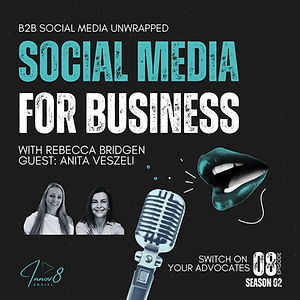
Your employees are on social media right now. Some of them are posting thoughtful and carefully crafted content that is quietly building your brand’s reputation while you read this. Most of them are scrolling. A handful of them, given the right support and the right permission, could become the most powerful marketing tool your business has ever had.
That is not motivational poster territory. It is something Anita Veszeli has been demonstrating empirically since 2012, when she launched one of the first employee advocacy programmes inside a global B2B technology company, at a time when the industry had not yet agreed on what to call what she was building. She started as a team of one at Ericsson, constructed a global programme from zero governance to a framework sophisticated enough to protect and enable the business simultaneously, and now operates as a fractional social media director helping senior leaders build programmes that hold together under the pressure of real organisational life.
Episode eight of the Social Media for Business podcast is the conversation every business owner and marketing leader in maritime has been needing without necessarily knowing it.
People-powered influence, not a corporate megaphone
The first thing Anita does is dismantle the prevailing definition. Employee advocacy is the term most people recognise, but in practice it is frequently reduced to something considerably less interesting. Employees become yet another distribution channel for corporate messaging. The company, the company, the company. People tune out. Reasonably so.
What Anita calls people powered influence is a fundamentally different proposition. It is about individuals sharing genuine expertise, considered perspective and actual personality in a way that builds credibility for themselves and, by extension, for the organisation they represent. The distinction is not semantic. It is the difference between a programme that compounds meaningfully over time and one that generates a brief flurry of enthusiasm before everyone quietly goes back to what they were doing before.
The commercial case is considerably stronger than most businesses appreciate
One of the most persistent objections to employee advocacy investment is that it feels insufficiently commercial compared to sales training or social selling tools. Anita addresses this directly and rather deftly. Executives, subject matter experts and engaged employees operate at the very top of the buyer funnel. They are responsible for the familiarity, trust and credibility that determine whether a potential customer places a business on their shortlist before a sales conversation has even been requested.
The evidence is compelling. Research indicates that 73% of B2B buyers trust thought leadership over any other form of marketing material. In organisations with complex multi-stakeholder buyer committees, human voices carry an authority that paid advertising structurally cannot replicate. Unlike a campaign that ceases to function the moment budget is withdrawn, content created by credible individuals compounds. Anita offers a personal illustration that is difficult to argue with. Someone discovered her through a LinkedIn article she had written six years previously and entirely forgotten about. It had been working autonomously and without remuneration for six years. No paid advertisement achieves quite that level of loyalty.
Senior leadership buy-in and management buy-in are categorically not the same thing
This is among the sharpest observations in the episode, and one that organisations consistently conflate at their peril. A chief executive can announce with considerable enthusiasm that employees are encouraged to be active on social media. If a team member then asks their line manager whether time spent on LinkedIn constitutes genuine work and receives a dismissive response, the initiative terminates at that precise moment regardless of what was said at the all hands meeting.
Research from Tribal Impact, cited by Anita, examined 860 companies and found that in 80% of cases, VP and director level activity reliably predicted employee activity. Where that management layer was actively engaged, employee participation was four times higher than in organisations where it was absent. The sphere of influence most proximate to an employee is not the C-suite. It is the person whose calendar invite they accept without hesitation. Securing genuine buy-in at that level is not a secondary consideration.
What managers are actually afraid of, and it is rarely what they say it is
The fears that inhibit managerial support for employee advocacy tend to cluster recognisably. Control is prominent. Comms and marketing have traditionally owned the organisational voice, and anything beyond that perimeter feels like reputational exposure. Risk follows closely. What if someone says something inadvisable? There is also the quietly persistent assumption, apparently surviving well into the mid 2020s, that time spent on LinkedIn is not really working.
Anita’s response is governance, and she is emphatic that governance should function as an enabler rather than a bureaucratic obstacle. People require clarity. They want to understand the parameters, identify the sensitive areas, know what to do if something goes wrong and understand who to consult when uncertainty arises. A well constructed framework answers those questions. Critically, it devotes considerably more space to articulating what people are free to do than to cataloguing what they cannot. Good governance illuminates the freedom, not merely the fence.
Start with a pilot, not a company-wide mobilisation
When Anita built the programme at Ericsson, she did not attempt to activate 50,000 employees simultaneously. That way lies chaos, or at least a very ambitious project plan. She identified the individuals already posting, already presenting at industry events, already intellectually engaged with their professional communities. She built cross functional coalitions so that success in one business unit became the evidentiary foundation for scaling. She ran monthly community meetings, celebrated the content generating genuine commercial responses, and deployed the examples of what was not working with the same candour as the success stories. That last part, it turns out, is rather important.
The January gym effect is as real in employee advocacy as it is in fitness. Motivation arrives in abundance at the outset. Consistency is considerably more demanding. Anita’s prescription is ten minutes per day, five days a week, beginning with observation and engagement before graduating to original content. Even a considered response to a colleague’s post requires minimal time investment and can carry disproportionate significance for the recipient.
What the employee actually gains
Beyond professional development and enhanced visibility, Anita advances a persuasive case for the personal value employees derive from consistent LinkedIn presence. A robust professional network constructed before it is urgently required. Access to expertise across sectors and disciplines. The credibility that accrues to those perceived as trusted voices within a specialisation. The career progression that follows, with surprising reliability, from being visible at all.
She is also careful to disabuse people of the notion that this is about self-promotion or the performance of professional confidence. LinkedIn is not Instagram. Nobody is asking for morning routines or smoothie opinions. What your analysis of the market looks like, what you have read recently, how you think about the problems your industry is actively grappling with, these are the foundations of professional connection and the currency from which trust is eventually built.
Where to begin
If there is a single actionable principle that every organisation should extract from this episode it is deceptively straightforward. Do not start with a platform. Start with the problem. What is the business genuinely trying to solve? Talent acquisition? Pipeline development? Reputation in a specific geography or sector? The answer to that question governs everything that follows, from pilot cohort selection to content strategy to measurement framework.
When a well supported employee eventually moves on, Anita’s perspective is admirably unsentimental. If they were treated with respect and invested in properly, they become alumni advocates rather than departures. The antidote to the fear of people leaving is not to withhold investment. It is to extend that investment to a sufficiently large number of people that no single departure creates a structural problem.
The organisations that master this possess a competitive advantage that is genuinely difficult to replicate at speed. It begins, as most durable advantages do, with the people already in the building.
🎧 Listen on Spotify: https://spotifycreators-web.app.link/e/Zp5Um6pnm7b
▶️ Watch on YouTube: https://youtu.be/o6Vv_bxFhiY


Comments